
How to get recommended by ChatGPT (with real numbers)
Ask ChatGPT which tool to use for a job your product does. Then ask Perplexity. Count how many answers name you.
For most small SaaS products, the count is zero. Not because the AI dislikes you, and not because your product is worse. It’s because of where the AI gets its recommendations from, and almost nobody building a product is looking there.
We measure this every week. This post shows what one real test found, why ChatGPT recommends some products and ignores others, and the five steps that get your product into the answer. No tricks, no prompt hacks.
The test: read 381 times, recommended 0 times
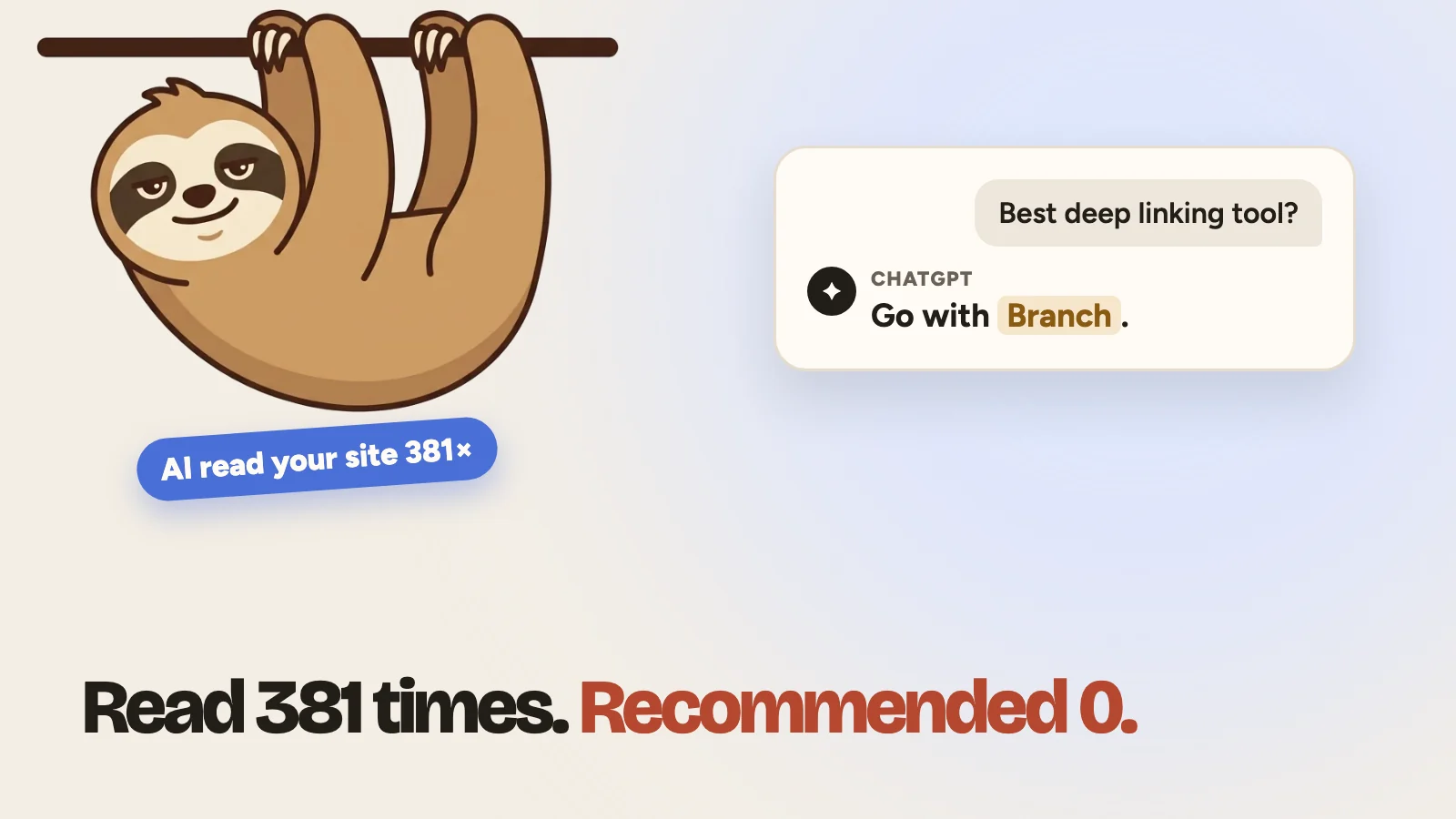
We picked a small developer tool in mobile deep linking, a category with one dominant player. We asked ChatGPT and Perplexity the questions its customers ask before they choose a tool, like “What is the best deep linking tool for a Flutter app?” and “What are the best alternatives to Branch?”. We asked each question three times, because AI answers change from run to run.
Out of 18 answers:
- The product was named 0 times.
- Its biggest competitor was named 15 times.
In the same month, the product’s own analytics showed that AI assistants opened its pages 381 times.
So the AI was reading the product’s website constantly. It knew the product existed and what it did. It just never recommended it.
Read 381 times. Recommended 0. AI reads you; it doesn’t recommend you. Those are two different things, and the gap between them is where small products lose customers they never knew they had.
Why this matters now
1 in 2 customers now ask AI before they ask Google. This is not a niche problem. In G2’s March 2026 survey of 1,076 people buying B2B software:
- 51% now start their research with an AI chatbot more often than with Google (up from 29% a year earlier).
- 69% chose a different vendor than they planned because of what the chatbot recommended.
The AI names three or four products, and most people never look further. If you’re not on that short list, you’re not in the deal.
Why doesn’t ChatGPT recommend my product?
When ChatGPT or Perplexity answers a question like “best X for Y”, it searches the web and builds the answer from a short list of pages it trusts for that question. Those are mostly:
- “Best X tools” lists and roundups, written by blogs, media and agencies.
- Review and directory sites such as G2, Capterra, AlternativeTo and Product Hunt.
- Community threads, especially Reddit.
- Comparison pages: “X vs Y” and “alternatives to X”.
- The product’s own website, but mainly for facts (pricing, features), not for the recommendation itself.
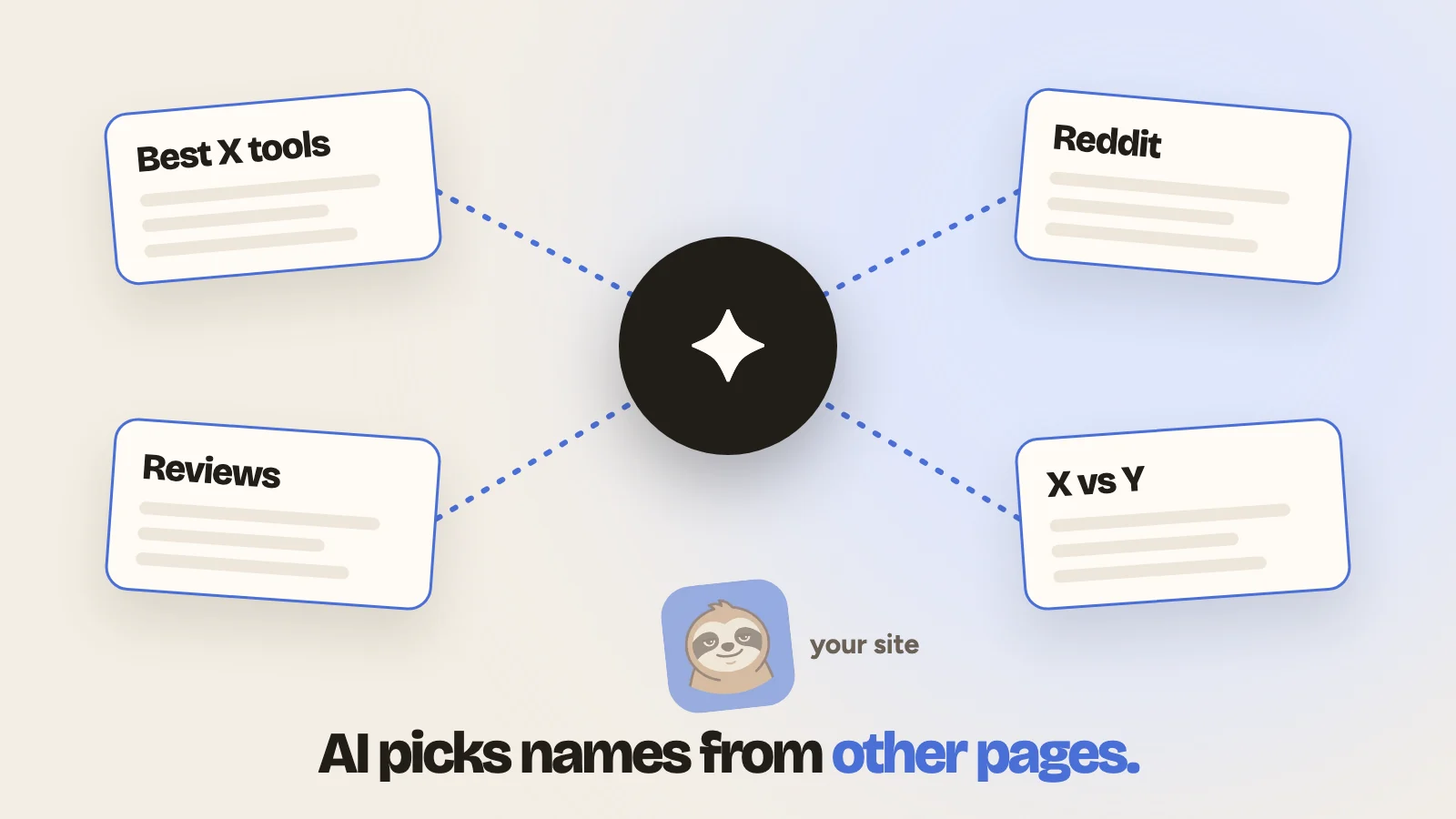
AI picks names from other pages. That explains our test. The AI read the product’s site 381 times to get facts. But when it decided which products to recommend, it took the names from lists, review sites and comparison pages. The competitor was on those pages. The product wasn’t.
Research backs this up. A January 2026 study of 112 Product Hunt startups found that ChatGPT recognised 99.4% of them by name, but recommended only 3.32% when asked open “best tool for…” questions (Perplexity: 8.29%). What went with being recommended: more sites linking to the product, and presence on Reddit. On-page optimisation scores had no correlation at all.
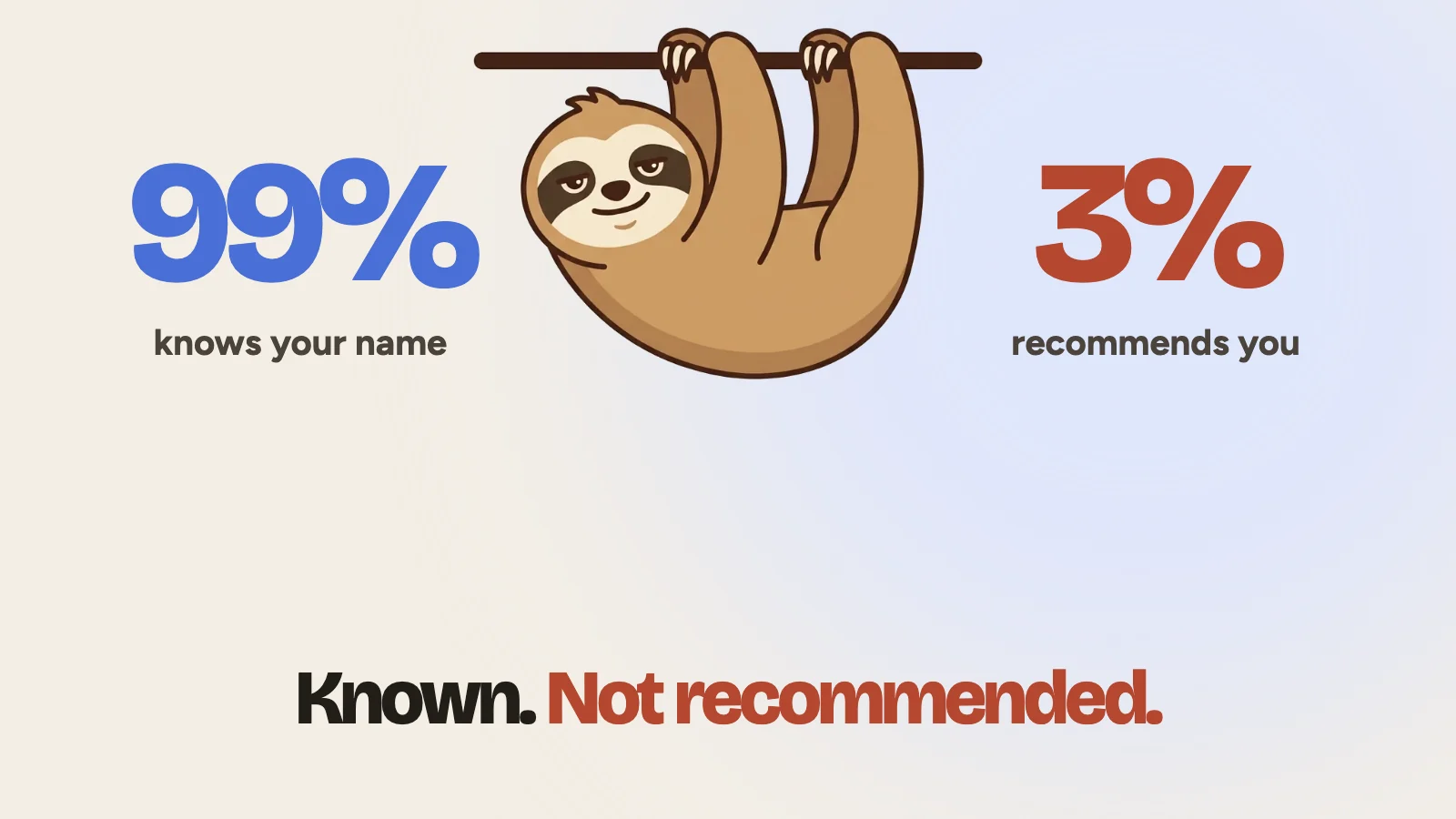
Known. Not recommended. In short: AI doesn’t recommend what it reads. It recommends what other pages say about you.
How to get recommended by ChatGPT: 5 steps
Step 1. Find the sources AI uses for your category
Before you change anything, find out where the answers come from.
- Write down 10 to 15 questions your customers actually ask before they buy: “best [category] for [audience]”, “alternatives to [market leader]”, “[competitor] vs [competitor]”, “[category] for [specific use case]”.
- Ask each one in ChatGPT and Perplexity, in the real apps, logged out. Ask each question two or three times. The answers vary.
- For every answer, note who was named and which pages were cited. Perplexity shows its sources by default; in ChatGPT, open the sources panel.
Test in the real apps, not only through an API. The brands named in ChatGPT’s app and in its API often differ, and the app is what your customers see.
The list of cited pages is your to-do list. That is where the recommendation is decided.
Step 2. Make your own site easy to quote
Your site doesn’t decide the recommendation, but it decides whether the AI gets your facts right when it does mention you.
- Say what you are in the first sentence: “[Product] is a [category] for [who] that [does what].” Use the words your customers use for the category, not your slogan.
- Put pricing on a plain, public page, readable without JavaScript and not hidden behind “Contact sales”. AI tools often fetch pages without running scripts; if your pricing loads by script, the AI sees an empty page.
- Publish comparison pages: “[You] vs [competitor]” and “[competitor] alternatives”. They match the exact questions people ask, and AI cites them often. Be fair to the competitor; a one-sided page reads as an ad.
- Answer real questions on real pages: use cases, FAQs, integrations.
- Check that robots.txt doesn’t block AI crawlers:
GPTBot,OAI-SearchBot,PerplexityBot,ClaudeBot.
Step 3. Get on the pages AI already trusts
This is the step that made the difference between 0 and 15 in our test, and it’s the one most founders skip.
- Directories and review sites. List your product on G2, Capterra, AlternativeTo, Product Hunt and SaaSHub, plus the niche directories for your category. Ask a few real customers for honest reviews.
- The lists AI cites. From step 1 you know which “best X tools” articles appear in the answers. Write to their authors, briefly and personally, with a real reason to include you: a feature the others lack, a price point, an audience. Don’t pay for placement and don’t send templates.
- Reddit and communities. Answer real questions in your niche honestly, and mention your product only where it genuinely helps. Spam gets removed, and it’s the fastest way to burn trust.
- Guest posts and your own articles on sites AI cites in your category.
Step 4. Keep the same facts everywhere
If your site says “free plan”, G2 says “from $29” and an old list says “$19 a month”, the AI has to choose. Usually it hedges, or leaves you out.
Use the same name, category, one-line description and pricing on your site, every directory and every profile. Update old listings when your pricing changes. It’s boring, and it’s one of the cheapest fixes there is.
Step 5. Check every week, and be patient
Re-ask the same questions on a schedule, ideally weekly, several runs each. Track how often you’re named, how often each competitor is named, and which pages are cited.
Set your expectations:
- Perplexity searches the web live and usually reflects changes first.
- ChatGPT tends to move more slowly.
- Expect first mentions in weeks to a couple of months, not overnight. Anyone who guarantees a ChatGPT recommendation is guessing.
What doesn’t work
- Keyword stuffing or hidden text “for AI.” There is no secret prompt, tag or file that makes ChatGPT recommend you.
- Fake reviews. They break the review sites’ rules and the law in most markets, and they get removed.
- Spamming Reddit or communities. It gets deleted, and it gets you banned from the places that matter.
- Only working on your own site. It helps the AI describe you correctly, but on its own it rarely gets you recommended. The test above is the proof: 381 reads, 0 recommendations.
FAQ
Can you pay to get recommended by ChatGPT? No. There’s no ad slot or submission form for ChatGPT’s recommendations. You can only make your product easier to find, check and cite on the pages it reads.
How long does it take to get recommended by ChatGPT? Usually weeks to a couple of months after you appear on the pages AI cites. Perplexity often changes first; ChatGPT follows more slowly.
Is this the same as SEO? It overlaps but isn’t the same. Classic SEO is about ranking your own pages in Google. Getting recommended by AI is mostly about being named on other pages that AI trusts.
Does llms.txt help? It can help AI tools read your site, but there’s no evidence it makes ChatGPT recommend you. Treat it as a small extra, not a strategy.
Should I check ChatGPT or Perplexity first? Both, but start with Perplexity: it shows its sources clearly, so it’s the fastest way to see which pages decide your category.
The short version
- Ask AI the questions your customers ask, and note which pages it cites.
- Make your site say clearly what you are, with public pricing and comparison pages.
- Get your product onto the lists, directories, review sites and threads AI cites.
- Keep your facts identical everywhere.
- Re-check weekly, and give it weeks, not days.
AI doesn’t recommend what it reads. It recommends what other pages say about you. So get on the pages AI reads. Then relax.
The relaxing part is ours. LazyGEO does steps 1 to 5 for small SaaS teams on autopilot: it re-asks your customers’ questions every Monday, publishes comparison pages, writes your directory entries and pitches the authors of the lists AI cites. Nothing goes out in your name without a 24-hour window and a Stop button. See what AI says about your product, free.